第 18 章 · Hopper ②:wgmma、warp specialization 与 persistent kernel
本地运行
git clone https://github.com/wikieden/cuda-to-tensor-core
cd cuda-to-tensor-core/code/notebooks
pip install jupyterlab torch numpy
jupyter lab ch18_warp_specialization.ipynb
也可以下载后直接用 VS Code 打开 .ipynb 运行。需要 GPU 的章节在 Colab 里选「代码执行程序 → 更改运行时类型 → GPU」。
本章回答:Hopper 的 Tensor Core 指令
wgmma和 Ampere 的mma.sync有什么不同?为什么要把 block 里的 warp 分成"搬运组"和"计算组"?环形缓冲区 + full / empty 两组 barrier 怎么配合?persistent kernel 解决什么问题?一个 H100 GEMM 怎么从 32 TFLOP/s 做到超过 cuBLAS?
讲解日期:2026-11-14 · 上一章:第 17 章 Hopper ① · 下一章:第 19 章 CuTe
对应原文:Pranjal「Outperforming cuBLAS on H100: a Worklog」(materials/text/blog-pranjal-outperforming-cublas-h100.txt全文 411 行,Kernel 1–11 在第 98–312 行);Colfax「Fast Matrix-Multiplication with WGMMA on NVIDIA Hopper GPUs」(text/blog-colfax-hopper-wgmma.txt);PTX §9.7.17 wgmma(text/ptx-isa-9.4-focus-mma-wgmma-tcgen05-tma.txt第 10053–12039 行);PG §4.12.1.3 Producer-Consumer Pattern Through Warp Specialization(text/cuda-programming-guide.txt第 19533–19710 行)、§4.10.7(第 18294–18583 行);FlashAttention-3 论文 §3.1(text/flashattention-3.txt第 208–298 行);GPU MODE L45(text/gpu-mode-lecture-45-outperforming-cublas-on-h100.txt);Hopper tuning guide §4.1.2(text/hopper-tuning-guide.txt第 160–185 行)本章缩写:wgmma = WarpGroup Matrix Multiply-Accumulate(warpgroup 级矩阵乘累加)· warpgroup(4 个连续 warp,128 个线程)· SS / RS-GEMM = 两个操作数都在 Shared / A 在 Register、B 在 Shared 的矩阵乘(FA3 论文用语)
讲解
第一步:wgmma——4 个 warp 一起、异步地算(2026-11-14)
PTX §9.7.17.1:warpgroup = 4 个连续的 warp(首个 warp 的编号是 4 的倍数),128 个线程。Hopper 的 Tensor Core 指令 wgmma.mma_async 让一个 warpgroup 合作算一个 m64nNk16 的矩阵乘,N 可以是 8、16、24……256(PTX §9.7.17.2 的形状表)。
和 mma.sync(第 15 章)比:
mma.sync(Ampere) |
wgmma.mma_async(Hopper) |
|
|---|---|---|
| 合作单位 | 1 个 warp | 1 个 warpgroup(4 warp) |
| 一条指令的大小 | m16n8k16(2048 次乘加) | 最大 m64n256k16(262144 次乘加) |
| 操作数位置 | A、B 都要先 ldmatrix 进寄存器 |
A 在寄存器或 shared,B 必须在 shared,直接从 shared 读;累加器在寄存器 |
| 同步性 | 同步:指令完成才往下走 | 异步:发出后线程继续,用 wgmma.commit_group / wgmma.wait_group 等 |
Gordić 的计算(第 760–770 行):m64n64k16 时,64 × 64 的累加器分给 128 个线程,每个线程拿 64 / 16 × 8 = 32 个 FP32 寄存器。
B 直接从 shared 读省掉了 ldmatrix,但要求 shared 里的布局符合 wgmma 的规定(带 swizzle 的"core matrix"排列,Colfax WGMMA 博客 "SMEM layout constraints" 一节)——这正好由 TMA 按 tensor map 里的 swizzle 模式直接写好(第 17 章)。
第二步:Pranjal 的前三步——从 32 到 423 TFLOP/s(2026-11-14)
H100 SXM 上 cuBLAS BF16 约 716 TFLOP/s(Pranjal 第 69 行)。
| Kernel | 做了什么 | TFLOP/s |
|---|---|---|
| 1 | 第 14 章的 warptiling 搬到 BF16(CUDA core) | 32 |
| 2 | 换成 TMA + wgmma + barrier | 317 |
| 3 | 更大的输出 tile:BM = BN = 128、BK = 64,用 m64n128k16 | 423 |
Kernel 2 一下子快 10 倍——这就是 Tensor Core 和 CUDA core 的差距(第 15 章)。Kernel 3 的经验:"It is always better to use the largest available instruction and set BN = WGMMA_N"——指令越大,每条指令的固定开销占比越小。
第三步:warp specialization——搬运组和计算组分开(2026-11-14)
Kernel 3 里同一个 warpgroup 既发 TMA、又等数据、又算 wgmma,"搬"和"算"还是串着的。第 16 章的多级流水线可以解决,但在 Hopper 上有更彻底的办法——warp specialization(warp 专业化)。Hopper tuning guide §4.1.2 把它列为 TMA 的好处之一:"Enables users to write warp specialized codes, where specific warps specialize on data movement……while other warps only work on local data within the SM."
Pranjal Kernel 4 把它讲成生产者–消费者问题:
- 生产者 warpgroup:只负责发 TMA,把 A、B 的 tile 一块块搬进环形缓冲区(circular buffer,QSIZE 个 slot);
- 消费者 warpgroup:只负责等数据、做 wgmma;
- 两组 barrier 协调:
full[i]:"slot i 装满了"——生产者(TMA 搬完)arrive,消费者 wait;empty[i]:"slot i 用完了"——消费者 arrive,生产者 wait。
生产者:                                 消费者:
for k:                                   for k:
  i = k % QSIZE                            i = k % QSIZE
  empty[i].wait()      ← 等 slot 空          full[i].wait()       ← 等 slot 满
  TMA 搬 A_k, B_k → slot i                   wgmma 用 slot i
  (TMA 完成时 full[i] 自动记账)              empty[i].arrive()   → 通知 slot 空了
初始化时让生产者"以为所有 slot 都是空的"。两边以各自的速度跑,谁快了就等对方——和工厂里的传送带一模一样。
结果:498 TFLOP/s(128 × 128 tile,QSIZE = 5)。
第四步:寄存器再分配与两个消费者(2026-11-14)
Kernel 5 想把输出 tile 做到 128 × 256,结果掉到 123 TFLOP/s:一个 warpgroup 128 个线程要放 128 × 256 = 32768 个累加器,每个线程 256 个——已经超过每线程 255 个寄存器的上限(第 5 章),溢出到 local memory。
解决办法:
- 两个消费者 warpgroup,各算 64 × 256 的一半:block 有 3 个 warpgroup(1 生产 + 2 消费),610 TFLOP/s;
- 寄存器再分配(
setmaxnreg):生产者只发 TMA,根本用不了多少寄存器;把它的寄存器上限压到 24,消费者提到 240(240 × 128 × 2 + 24 × 128 = 64512 ≤ 65536),631 TFLOP/s。FlashAttention-3 算法 1 第 3、12 行做的是同一件事:"Deallocate / Reallocate predetermined number of registers"。
第五步:persistent kernel 与调度顺序(2026-11-14)
Kernel 6 起的思路:只启动 132 个 block(= SM 数),每个 block 循环处理多个输出 tile,这叫 persistent kernel(常驻 kernel)。好处:
- 算完一个 tile 写回结果时(store 要几千个周期),生产者已经开始搬下一个 tile的数据——store 的延迟被藏起来;
- 没有第 2 章的"最后一波不满"问题,可以自己决定 tile 分配;
- 可以控制 tile 的处理顺序来提高 L2 命中:Pranjal 把 tile 按 16 × 8 的组排,L2 命中率 83%(cuBLAS 70%),660 TFLOP/s;最后用 Hilbert 曲线排 tile,再涨 1%。
一个反直觉的细节(第 226 行):用 128 个 SM 反而比用满 132 个快(655 vs 660),因为 tile 正好整除成 16 × 8 的组。
第六步:剩下的几步与全景(2026-11-14)
| Kernel | 改动 | TFLOP/s | 相对 cuBLAS |
|---|---|---|---|
| 1 | CUDA core warptiling | 32 | 4% |
| 2 | TMA + wgmma | 317 | 44% |
| 3 | 大 tile、大指令 | 423 | 59% |
| 4 | warp specialization | 498 | 70% |
| 5 | 2 个消费者 + 寄存器再分配 | 631 | 88% |
| 6 | persistent + tile 分组提高 L2 命中 | 660 | 92% |
| 7 | 更快的 barrier API | 704 | 98% |
| 8 | thread block cluster(TMA multicast) | 734 | 102% |
| 9–10 | 微优化、异步 store | 758 | 106% |
| 11 | Hilbert 曲线排 tile | 764 | 107% |
(数字来自 Pranjal 博客第 100–312 行,H100 SXM、BF16。超过 cuBLAS 是在他测的特定尺寸上,不代表所有尺寸。)
FlashAttention-3 用的是同一套结构(论文 §3.1、算法 1):生产者 warpgroup 用 TMA 把 K、V 块装进 s 级环形缓冲区,消费者 warpgroup 做两次 GEMM(QKᵀ 和 PV)加 softmax;论文还加了"乒乓调度"——两个消费者 warpgroup 错开,一个算 softmax 时另一个用 Tensor Core(第 22 章)。
动画演示:生产者–消费者环形缓冲区
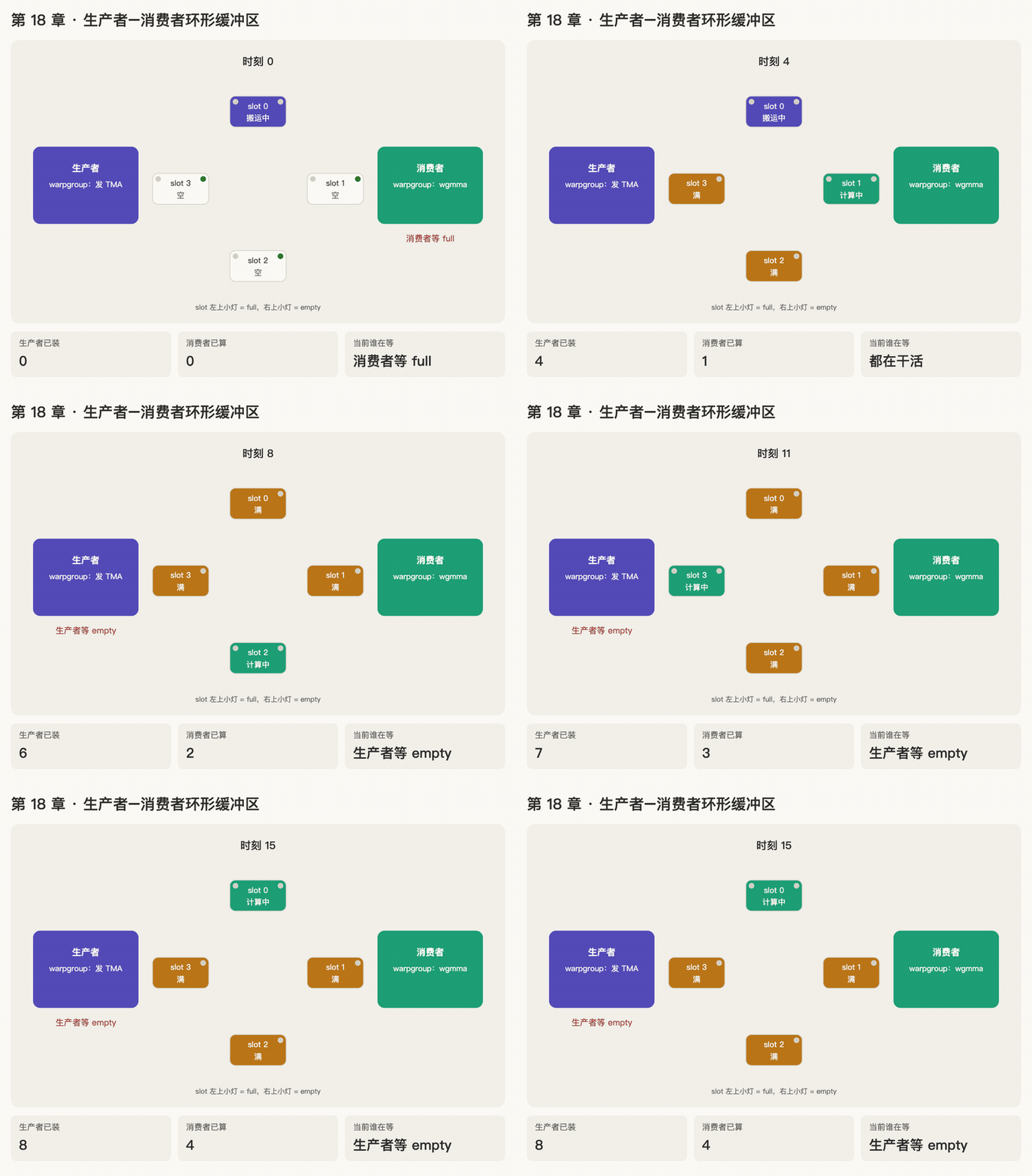
可交互版:animations/18-warp-specialization.html。开关:slot 数(2 / 4)、谁更快(生产者快 / 消费者快)。
怎么看:
- 中间是一圈环形缓冲区,每个 slot 标着"空 / 搬运中 / 满 / 计算中";
- 左边生产者每一帧拿一个空 slot 发 TMA,右边消费者拿一个满 slot 做 wgmma;
- 每个 slot 旁边两个小灯:full 和 empty barrier 的状态;
- 调成"生产者快",看缓冲区很快被装满、生产者开始等 empty;调成"消费者快",看消费者等 full。
练习与作答记录
题 1:wgmma m64n256k16、累加器 FP32。一个 warpgroup 每个线程要多少个寄存器放累加器?为什么 Pranjal 的 128 × 256 输出 tile 用一个消费者 warpgroup 时性能暴跌?
作答:(待作答)
题 2:环形缓冲区 QSIZE = 3。按顺序写出生产者处理第 0、1、2、3 块时分别要等哪个 barrier、写进哪个 slot;消费者处理第 0 块完成后要做什么,才能让生产者搬第 3 块?
作答:(待作答)
题 3:persistent kernel 只启动 132 个 block。和"每个输出 tile 一个 block"相比,它在 store 延迟、尾部效应、L2 命中三方面各有什么好处?
作答:(待作答)
口诀
wgmma:四个 warp 一起、一条指令一大块、B 直接从 shared 读、发了就走;
分工:搬运组只发 TMA,计算组只做 wgmma;
环形传送带两盏灯:full 亮了消费者拿,empty 亮了生产者装;
寄存器劫贫济富:搬运组只留 24 个,计算组拿 240 个;
常驻 132 个 block 循环干:store 时就搬下一块,tile 排好顺序吃 L2。
本章复习卡片
- C42(wgmma 与 mma.sync 的四点不同:warpgroup、m64nNk16、B 在 shared、异步)
- C43(warp specialization:生产者 / 消费者 warpgroup、环形缓冲区、full / empty barrier、
setmaxnreg寄存器再分配) - C44(persistent kernel:block 数 = SM 数、循环取 tile;藏 store 延迟、消尾部、控制 tile 顺序提高 L2 命中)
附录 · 延伸阅读
留给以后深入学习用,不影响本章主线。★ 是建议先读的。
推荐阅读
| 读什么 | 读哪里 | 读它为了什么 |
|---|---|---|
| ★ Pranjal「Outperforming cuBLAS on H100」 | text/blog-pranjal-outperforming-cublas-h100.txt 第 98–312 行 |
本章主线,每一步的代码与 profiling |
| ★ Colfax WGMMA 教程 | text/blog-colfax-hopper-wgmma.txt(WGMMA 第 43 行、SMEM 布局约束第 151 行、同步第 315 行、core matrices 第 362 行) |
用 CuTe 写 wgmma 的细节 |
| ★ FlashAttention-3 §3.1–3.2 | text/flashattention-3.txt 第 208–369 行 |
warp specialization + 乒乓调度 + GEMM / softmax 重叠 |
| PTX §9.7.17 | text/ptx-isa-9.4-focus-mma-wgmma-tcgen05-tma.txt 第 10053–12039 行 |
warpgroup 定义、形状表、wgmma.fence / commit_group / wait_group |
| PG §4.12.1.3、§4.10.7 | text/cuda-programming-guide.txt 第 19533–19710、18294–18583 行 |
官方的 warp specialization 例子 |
| GPU MODE L45 | text/gpu-mode-lecture-45-outperforming-cublas-on-h100.txt |
Pranjal 本人的讲座字幕 |
| gau-nernst「tcgen05 for dummies」Warp specialization / Persistent kernel 两节 | text/blog-gau-nernst-tcgen05-for-dummies.txt 第 793–917、992–1066 行 |
同一套结构在 Blackwell 上(第 20 章) |
code/fast-cu/ |
Pranjal 的代码 | M5 里程碑对照 |
数学原理
- wgmma 累加器寄存器:m64nN 的 FP32 累加器有 \(64N\) 个数,分给 128 个线程,每线程 \(N/2\) 个寄存器;N = 256 时为 128 个——再加上 A 的寄存器和地址变量,接近 255 的上限。
- 寄存器预算:\(R_{\text{prod}} \cdot 128 + R_{\text{cons}} \cdot 128 \cdot n_{\text{cons}} \le 65536\)。
- 环形缓冲区所需 slot 数:要藏住一次 TMA 的延迟 \(L\),slot 数 \(\ge 1 + L / t_{\text{wgmma}}\)(Little 定律);但 shared memory 有限,大 tile 时只能少开几个 slot(Pranjal 从 5 降到 3)。
公式 / 代码清单
| 名称 | 代码 |
|---|---|
| wgmma | wgmma.mma_async.sync.aligned.m64n128k16.f32.bf16.bf16 {d...}, descA, descB, ...; |
| wgmma 同步 | wgmma.fence.sync.aligned; → 若干 wgmma.mma_async → wgmma.commit_group.sync.aligned; → wgmma.wait_group.sync.aligned N; |
| 寄存器再分配 | setmaxnreg.dec.sync.aligned.u32 24;(生产者) / setmaxnreg.inc.sync.aligned.u32 240;(消费者) |
| 生产者循环 | empty[i].wait(); arrive.expect_tx(full[i], bytes); TMA(A_k, B_k → slot i, full[i]); |
| 消费者循环 | full[i].wait(); wgmma(slot i); empty[i].arrive(); |
| 编译目标 | -arch=sm_90a(wgmma、setmaxnreg 只在 sm_90a 上可用) |
代码对照:把本章的数字用代码算一遍
用 NumPy 在 CPU 上模拟同样的规则。代码在仓库本地
cuda-programming/solutions/chapter-code/ch18_warp_specialization.py,配套测试tests/test_ch13_18.py;同一章的 notebook:notebooks/ch18_warp_specialization.ipynb(讲解和代码放在一起,一格一格边读边跑)。在线版不带代码文件,下面摘了关键几行。Mac 上直接能跑,不需要 GPU(wgmma / setmaxnreg 要 sm_90a 的 GPU [GPU];这里只算寄存器账和模拟环形缓冲区):
bash
cd cuda-programming/solutions/chapter-code
uv run python ch18_warp_specialization.py   # 一步一步打印
uv run pytest tests/test_ch13_18.py
讲义 ↔ 代码:
| 讲义 | 公式 / 说法 | 写法 | 跑出来 |
|---|---|---|---|
| 第一步 m64n64 累加器 | 64 × 64 ÷ 128 | accum_regs_per_thread(64, 64) |
每线程 32 个 |
| 第三步 生产者 / 消费者 | full / empty 两组 barrier | run_ring(20, 5, 2, 1) |
消费者按顺序拿到 20 块;生产者快时要等 empty |
| 第四步 128 × 256 一个消费者 | 32768 ÷ 128 | accum_regs_per_thread(128, 256) |
256 > 255,溢出 |
| 第四步 寄存器再分配 | 240 × 128 × 2 + 24 × 128 | register_budget(24, 240) |
64512 ≤ 65536 |
| 第六步 全景 | ÷ cuBLAS 716 | PRANJAL |
4% → 107% |
关键几行:
i = produced % qsize
if not empty[i]: break        # empty[i].wait():slot 还没用完,生产者等
slots[i] = produced           # TMA 搬 A_k、B_k → slot i
full[i] = True                # TMA 完成时 full[i] 自动记账

i = consumed % qsize
if not full[i]: break         # full[i].wait():数据还没到,消费者等
got.append(slots[i])          # wgmma 用 slot i
empty[i] = True               # empty[i].arrive()
代码里才看得到的 3 件事:
empty初始全是 True:对应讲义说的"初始化时让生产者以为所有 slot 都是空的",否则第一块谁也开始不了。- "一拍"是编的时间单位:
producer_speed=2表示生产者每拍能装两块;只用来看"谁快谁等",不对应真实周期。 - Kernel 8 算出来是 102.5%:734 / 716 = 1.025,讲义表写 102%(截断),测试按 102–103 之间核对。
自己改一改(不影响练习答案):
- 把
run_ring的 QSIZE 从 5 改成 1、2,生产者快的时候看它等了多少拍。 - 用
register_budget试试生产者留 40 个、消费者 232 个,看还放不放得下。